
Once you try to produce a stream of drops at a steady rate, you begin to realize it isn’t as simple to do as it is to say. The temptation is to use a siphon or IV drip of some kind. The problem with these is that the amount of pressure behind the stream is dependent on the water level. As the level decreases, so does the pressure, and the rate of flow.
I ran across the solution to this a few years ago (having a degree in physics, I am ashamed to say that I didn’t know of it before). It is called the “Mariotte siphon”. It is well-known to people who do irrigation in rural areas, as a simple concrete box of this design can deliver a steady flow of water to a field. The basic diagram is:
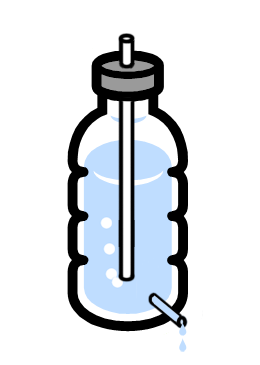
Mariotte Siphon
Cleverly simple and quite effective. The head (pressure) is dependent on the height between the bottom of the vertical tube and the final outlet of the liquid. The level of liquid in the bottle is irrelevant. I have built one using a soda bottle, a plastic drinking straw, and epoxy.
Out of a lack of any kind of technical knowledge of this sort of thing. What do you use to stop the end of the lower straw and control the flow?
Brendan,
I attach small vinyl tubing (like 3/16 inch) that runs down to an electromagnetic solenoid valve which starts and stops the flow.
Martin
I am in complete awe of your work. I found the site a long time ago and have shared the link on some photography sites.
I do not have your equipment…just a DSLR with an external flash unit, and I have not even been able to come close to what you do, but it’s fun trying!
Your work is amazing, and every now and then I go back to your images so that I can ooooh and aaaahhhh over them.
Temperature effects can alter the gas pressure in the headspace. In the US Southwest temperatures can change by as much as 40 degree F within 24 hrs. How much will the flow vary as a result of these temperature swings?
Fernando,
Good question.
I think that the only thing that determines the rate of flow is the difference in height between the bottom of the vertical tube and the outlet below. Normally, the tube is completely full of air, bubbling out a bit as the liquid is dispensed.
If the temperature increases, the air inside the bottle will expand and drive a bit of liquid up the tube (or, if the siphon is running, it will increase the rate of flow.) This soon equalizes the pressure with the outside air. Then, the siphon will return to its normal rate . (Because the air pressure at the two ends of the siphon is equal, it will provide no force on the liquid.)
If, instead, the temperature drops, the air inside the bottle will contract, pulling in a bit more air down the vertical tube to equalize the pressure. This won’t have even a temporary effect on the rate of flow since the force of the pressure differential will all be used to draw air down the tube rather than retard the liquid from falling out of the siphon.
Martin
Great work Martin. I’ve done some of these shots and become more interested lately. Can you provide more information on the electromagnetic solenoid valve. Where can one be purchased and how do you control it? Thanks
Thanks, John.
The solenoids I use I salvaged from some odd piece of medical equipment I picked up surplus, so I can’t tell you much about their provenance. However, various workable devices should be available online. You’ll want one that operates on 12 or 24V, I suppose, and you should make sure that it is a “low pressure” variety (the higher pressure types require a minimum of 3 or 4 psi to operate, which a gravity-fed dropper won’t have.) Jameco.com seems to have one currently, but I can’t quite tell if it is suitable for liquids.
You can control it with a simple pushbutton, if you want to do it manually. For full automatic control, I use a logic-level FET (IRL510). Depending on the current requirements of the solenoid, you can get by with a medium power bipolar transistor (e.g., 2N2222), also. You’ll want to put a diode (1N4004 or so) in parallel with the solenoid to snub back EMF when the power is shut off (or you’ll pop your transistor, experience tells me).
Best of luck!
Martin
Thanks Martin. I work in the medical industry myself. We always have a bunch of old equipment around headed for the trash heap. MAybe I can salvage something. Do you remember what type of device had a solenoid in it?
Thanks again
John
John,
I have the device here in my hand, but one can only imagine what its purpose was. I only have the innards, and there are no identifiable markings on it. It had eight solenoids connected to a multi-chambered plastic drum about six inches in diameter and eight inches tall. I only surmise that it was medical equipment from the treatment of the connections (all sealed with silicone) and the liberal use of stainless steel screws.
Sorry,
Martin
Thanks for the description, but I agree its a bit difficult to fathom the device’s original purpose based on that information. The Jameco lead was very helpful though as were the rest of your suggestions. Thanks for all your assistance, and have a Happy New Year!
Hi Martin,
Great work! Thanks for all the tips. I am just getting started in high speed photography. I have a couple of questions on Mariotte Siphon.
1. Would I be able to get 10 drops per second flow rate just by adjusting the air tube (vertical tube)? Or do I need to use some kind of flow control (like compressing the outlet tube)?
2. You mentioned you have automatic control of the solenoid valve. What kind of control does it do? Is it to control how long the solenoid is open?
I have an 8 year old Basic Stamp 2. I am able to get the delay at 1ms resolution using the standard DELAY operation.
Regards,
Viru
Viru,
No, the air tube needn’t be adjusted. Just raise/lower the height of the bottle. Build one, play with it, all will become clear.
Yes, the control for the solenoid opens and closes it.
Martin
Hi Martin,
Thanks for the response. I made a Mariotte Siphon using a sippy cup. I just had to put a whole for the outlet pipe. Vertical pipe was already in place. I can see how it works!! Its great.
I was looking for a solenoid valve and came across these 5 valves:
http://www.valvestore.com/products.asp?dept=1582
They all look same except for orifice size and max pressure.
Minimum pressure is 0. While I don’t care for max pressure, I have no clue as to what orifice means. Could you suggest which one is suitable for a Mariotte Siphon?
Regards,
Viru
Viru,
I don’t have experience with those devices, so I can’t make an informed recommendation. I believe that “orifice” means the hole that the liquid passes through. I would think that 7/64 would be good, but that is still a guess.
Best of luck.
Martin
Hey very nice blog!! Man .. Beautiful .. Amazing .. I will bookmark your blog and take the feeds also…
Hi Martin,
I appreciate your work, learned a lot from your blog.
I do splash photography too, and I’m considering making a Mariotte Syphon to get a more constant flow of drops for collision splashes.
I do collision photos already, with a normal bottle, solenoid and electronic control I designed myself.
My question is:
I use a flexible hose tubing to connect from the bottle to the solenoid.
With a Marriote Syphon, will the difference on height from the bottle to the solenoid affect the flow?
e.g.
setup 1: bottle 50 inches high, and solenoid 30 inches high, distance = 20inches
setup 2: bottle 80 inches high, and solenoid 30 inches high, distance = 50 inches
I know the height difference from the solenoid to the surface where the splash happens affects the height of the splash.
Check out my splash work here:
http://www.flickr.com/photos/chavals/sets/72157603971576913/
Thnx martin. Am helping my students for a national level science show competition. They chose the mariotte siphon experiments testing different variables. Am cracking my head trying to simplify the inferences to these 2 fourteen year old girls. But your blog helps. Keep up the good work
How do you control the drops, can it be connected to Arduino, where does the solenoid valve come into this set up?
Melody,
Cognisys has a fine setup (http://www.cognisys-inc.com/HowTo/water_drops.php) for doing this kind of work. If you want to control their solenoid valve from an Arduino, you will need a digitally controlled switch of some kind since the valve runs at 12VDC 0.55mA (6.5W). One choice would be a solid state relay like the CPC1218. This is nice because it gives complete isolation between the 12V side and the 5V side. You could also use an FET like the IRL510 or an IGBT like the IRGR3B60KD2PbF, but you may want an optoisolator between them and the solenoid.
I hope this helps.
Thinking about this a bit more, a humble 2N2222 would probably work just fine also. You will also want a snubber diode across the solenoid as it will generate a back EMF when it is turned off.